‘Delimitation won’t reduce South’s share in Lok Sabha’: Amit Shah breaks down the numbers
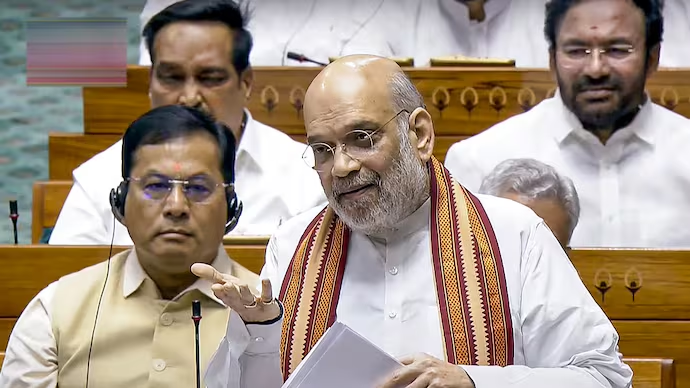
Union Home Minister Amit Shah on Thursday sought to allay concerns among southern states over the proposed delimitation exercise, asserting that their representation in the Lok Sabha will not diminish after the process is undertaken.
Addressing a public forum, Shah said apprehensions that southern states would lose parliamentary seats due to population control measures were “misplaced” and “not backed by facts”. He emphasized that the Centre is committed to ensuring equitable representation while maintaining the federal balance.
Concerns over delimitation
The issue of delimitation the redrawing of parliamentary constituencies based on population has sparked political debate, particularly in southern states such as Tamil Nadu, Kerala, Karnataka, and Andhra Pradesh. These states have historically performed better in controlling population growth compared to several northern states.
Political leaders in the South have argued that a population-based redistribution of seats could penalize them for effective governance, potentially reducing their share in Parliament while increasing representation for more populous northern states.
However, Shah categorically rejected this narrative.
Shah presented the numbers each state will get in proportion, following the passage of the Constitution (One Hundred and Thirty-First Amendment) Bill, 2026.
- Karnataka has 28 seats in the Lok Sabha at present, representing 5.15% of the House. After delimitation, the number of seats will increase to 42, representing 5.14% of the expanded House.
- Andhra Pradesh has 25 seats representing 4.6% of the House and after delimitation, it will have 38 MPs representing 4.65% of the House.
- Tamil Nadu – Shah noted several MPs wearing black in protest will see the number of MPs go up from 39 to 59, increasing its share in the House from 7.18% to 7.23%.
- Kerala, the Home Minister said, will see the number of Lok Sabha MPs go up from 20 to 30, with its share in the House changing from 3.68% to 3.67%.
- Telangana has 17 seats, or 3.13% of the Lok Sabha strength, at the moment. This will increase to 26 seats, representing 3.18% of the expanded House.
In total, Shah said, the southern states have 129 MPs in the 533-member Lok Sabha, representing 23.76% of its MPs. This will increase to 195 seats in the expanded Lok Sabha, increasing representation to 23.97%. The South’s representation, he said, was going up and not down, he said.
Shah’s numerical explanation
Breaking down the numbers, Shah explained that the total number of seats in the Lok Sabha is expected to increase significantly after delimitation, rather than being redistributed within the existing cap of 543 seats.
“At present, the seat allocation is frozen based on the 1971 Census. When delimitation happens, the total number of seats will rise, and every state will see an increase in absolute numbers,” Shah said.
He clarified that while northern states with higher populations may gain more seats in absolute terms, southern states will also gain seats proportionally, ensuring that their political voice is not weakened.
“For example, if a southern state currently has 40 seats, it may increase to 55 or 60 after delimitation. The share will remain broadly similar, even if the total House size expands,” he noted.
No reduction in proportionate share
Shah stressed that the government is conscious of the contribution of southern states to the country’s economic growth and governance benchmarks. He reiterated that there is no proposal to reduce their proportional representation.
“The idea is not to take away seats from one region and give them to another. The idea is to expand representation in line with population growth while keeping regional balance intact,” he said.
According to Shah, fears stem from the assumption that delimitation would occur within the existing seat framework. “That is not how it will be done. The total strength of the House will be increased,” he added.
Background of the freeze
Delimitation in India has been frozen since the 1970s through constitutional amendments, primarily to encourage population control measures. The freeze was extended until 2026, after which a fresh delimitation exercise is expected.
Shah pointed out that the freeze was originally intended to ensure that states implementing population control policies were not disadvantaged. He indicated that the Centre remains sensitive to this principle.
Political reactions
Despite Shah’s assurances, opposition leaders from southern states have continued to express caution. Some have demanded a clear framework or formula before the exercise begins, while others have called for consultations with all states.
Leaders argue that even a marginal reduction in proportional share could impact federal dynamics and policy priorities at the national level.
However, Shah maintained that the Centre will engage with all stakeholders before finalising any decision. “There will be wide consultations. No state’s interest will be compromised,” he said.
Way forward
The delimitation exercise is expected to take place after the next Census, which has been delayed. Once conducted, a Delimitation Commission will be set up to redraw constituency boundaries and recommend seat allocations.
Shah’s remarks appear aimed at building consensus ahead of what is likely to be a politically sensitive process.
He concluded by reiterating that India’s unity lies in balancing regional aspirations with national priorities. “Every part of the country is important. The delimitation process will reflect that spirit,” he said.
As the debate continues, the Centre’s assurances will be closely scrutinised, particularly by southern states seeking clarity on how their representation in the Lok Sabha will evolve in the coming years.
About the Author