Women’s Reservation Bill Defeated in Lok Sabha, Fails to Secure Two-Thirds Majority
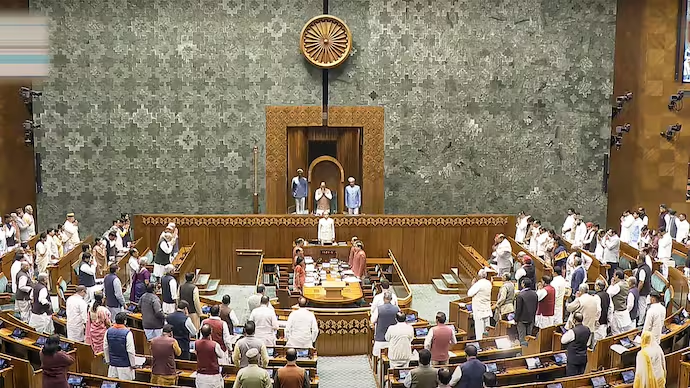
In a major legislative setback for the government led by Narendra Modi, the Women’s Reservation Bill was defeated in the Lok Sabha on Friday after it failed to secure the constitutionally mandated two-thirds majority. The development marks the first instance in 12 years that a constitutional amendment Bill introduced by the Modi government has not been passed by the Lower House.
The Bill, which sought to reserve 33 per cent of seats in the Lok Sabha and state legislative assemblies for women, fell short during voting despite an intense debate and a high-stakes political build-up. While a simple majority was achieved, the numbers did not meet the special majority threshold required for constitutional amendments under Article 368.
Voting Outcome and Numbers
According to parliamentary sources, the Bill received significant support across party lines but failed to cross the two-thirds mark of members present and voting. Several opposition parties either abstained or voted against the measure, citing concerns over implementation timelines, sub-quotas for backward classes, and procedural issues.
The treasury benches appeared confident ahead of the vote, but last-minute dissent and strategic abstentions altered the arithmetic. The final tally exposed cracks in the broader consensus that had been projected publicly.
A Rare Legislative Defeat
This is the first time since 2014 that a constitutional amendment introduced by the Modi government has been defeated in Parliament. Over the past decade, the government has successfully pushed through several key constitutional changes, often navigating complex political negotiations to secure the required majority.
Political observers described the outcome as a “significant symbolic and legislative setback,” particularly given the government’s strong numerical position in the Lok Sabha.
The Bill required a special majority of both Houses to get passed meaning two-thirds of those present and voting, which should not be less than one half of the total strength of the House. With 540 members currently in Lok Sabha, the Bill required 360 votes in favour. Only 298 members voted in its favour.
Political Reactions
Leaders from the ruling coalition expressed disappointment but maintained that the government remained committed to women’s empowerment. Senior ministers indicated that efforts would continue to build consensus and reintroduce the Bill in the future.
Opposition parties, meanwhile, presented mixed reactions. While some reiterated their support for women’s reservation in principle, others argued that the Bill in its current form lacked inclusivity. Demands for sub-quotas for Other Backward Classes (OBC) women were prominently raised during the debate.
A section of opposition leaders also questioned the timing of the Bill, suggesting it was brought forward without adequate consultation.
Background and Significance
The Women’s Reservation Bill has a long and contentious history in Indian politics. First introduced in the 1990s, it has seen multiple attempts at passage, including approval in the Rajya Sabha in 2010, but has repeatedly stalled in the Lok Sabha.
The Bill is widely viewed as a transformative measure aimed at increasing women’s representation in legislatures, where participation remains significantly low compared to global averages.
Its defeat underscores the persistent political divisions surrounding the issue, even as there is broad rhetorical support for gender parity in governance.
What Lies Ahead
Government sources indicated that consultations with political parties and stakeholders would be intensified in the coming months. There is a possibility that a revised version of the Bill, addressing concerns raised during the debate, could be brought back to Parliament.
For now, however, the failure to pass the Bill represents a missed opportunity to enact one of the most significant electoral reforms in recent years.
Broader Implications
The outcome is expected to have political ramifications, particularly as it comes ahead of key state elections. Analysts suggest that the government may face criticism for failing to secure sufficient support despite its parliamentary strength.
At the same time, the debate has reignited discussions on electoral reforms, representation, and the need for consensus-driven policymaking in matters of constitutional importance.
As Parliament adjourned after the vote, the defeat of the Women’s Reservation Bill stood out as a rare moment of legislative resistance in an otherwise dominant decade for the ruling dispensation.
About the Author