SC Allows Basant Panchami Prayers and Namaz at Bhojshala, Recalling the Long-Running Dispute
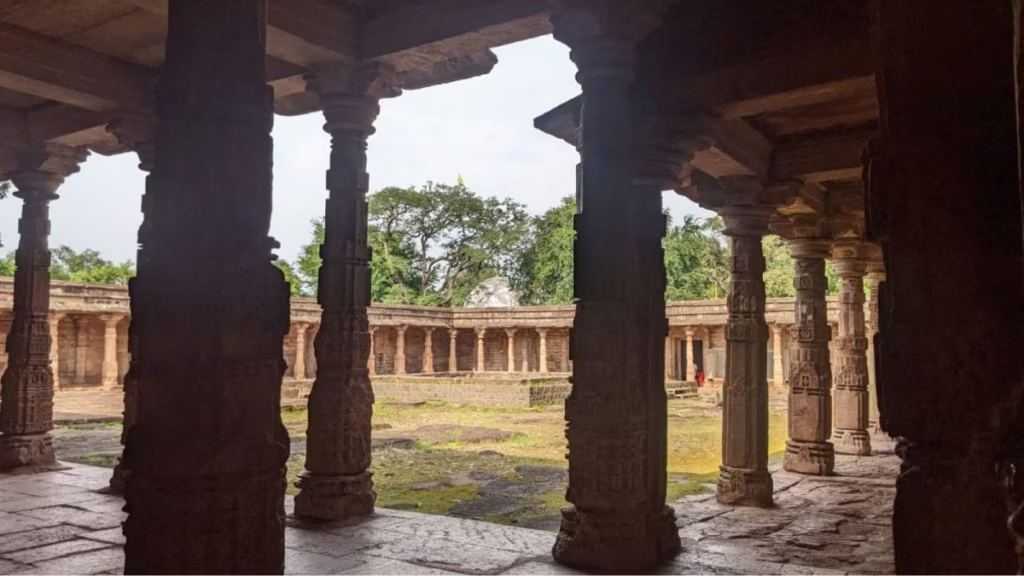
New Delhi/Dhar: The Supreme Court of India on Monday allowed the continuation of Basant Panchami prayers by Hindus and namaz by Muslims at the disputed Bhojshala complex in Madhya Pradesh’s Dhar district, declining to interfere with a long-standing administrative arrangement governing religious practices at the site.
Hearing petitions linked to the historical and religious character of Bhojshala, also known as the Kamal Maula Mosque, the apex court said the existing practice should not be disturbed at this stage, stressing the need to maintain communal harmony and public order while legal proceedings continue.
The court clarified that its order does not amount to a final determination on ownership or the religious nature of the structure. It said interim directions were limited to ensuring that established arrangements remain in force until competent courts decide the substantive issues.
Background of the Dispute
Bhojshala is an 11th-century structure located in central Madhya Pradesh and is widely associated with King Bhoja of the Paramara dynasty. Hindu groups claim the site was originally a Saraswati temple and centre of learning, citing inscriptions and architectural elements they argue point to a temple origin.
The Muslim community, however, maintains that the structure is the Kamal Maula Mosque and has been used for Islamic prayers for centuries. The competing claims have made the site a recurring flashpoint, particularly during major religious occasions.
Administrative Arrangement
During the colonial period, British authorities introduced restrictions on access to prevent clashes. After Independence, the site remained under regulated use. In 2003, the Madhya Pradesh government formalised a day-specific arrangement, permitting Hindus to offer prayers on Basant Panchami and Muslims to perform Friday namaz and prayers on Islamic occasions.
That arrangement has since been challenged in courts by petitioners from both communities seeking exclusive worship rights or fresh surveys of the structure.
Court’s Approach
The Supreme Court has repeatedly underlined the need for restraint in matters involving religious sites. In its latest order, the court indicated that altering a decades-old practice through interim directions could have law-and-order implications and should be avoided.
The bench said questions relating to history, archaeology and religious character must be examined on evidence by appropriate courts, and not prejudged at the interim stage.
Significance
The ruling ensures that religious practices at Bhojshala will continue under regulation, even as the broader dispute remains unresolved. By maintaining the status quo, the court has sought to balance competing claims while prioritising peace and stability at a sensitive site.
Further hearings in connected cases are expected as litigation over Bhojshala continues.
About the Author