Lottery to Decide Mumbai Mayor as Reservation Draw Takes Centre Stage
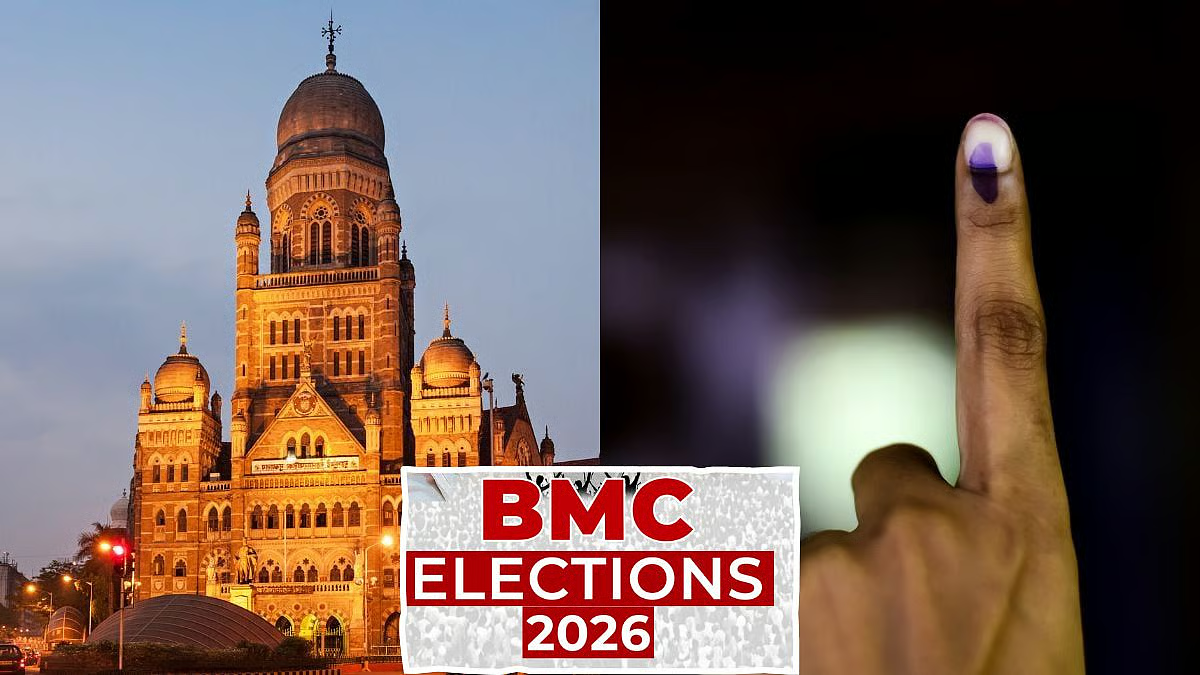
Mumbai is set to witness an unusual yet constitutionally mandated process to determine who can occupy the city’s top civic post next. A lottery-based reservation draw will decide the category from which the next Mayor of Mumbai will be elected, a process expected to take about a week and one that has already triggered intense political calculations within the city’s municipal establishment.
The exercise is linked to the long-pending elections to the Brihanmumbai Municipal Corporation (BMC), India’s richest civic body. Once elections are conducted and corporators are elected, the mayoral post will not be open to all councillors. Instead, eligibility will depend entirely on the outcome of the reservation lottery.
Why a Lottery Decides the Mayor
Under the Maharashtra Municipal Corporation Act, the mayoral post in municipal corporations is reserved on a rotational basis for specific social categories. These include:
Scheduled Castes (SC)
Scheduled Tribes (ST)
Other Backward Classes (OBC)
Women (from any of the above or general category)
Open (unreserved) category
The category for the mayor is decided through a draw of lots conducted by the state government, usually in the presence of senior officials and political representatives. This ensures rotation and prevents any single group from monopolising top civic positions over successive terms.
In Mumbai’s case, officials said the draw process including notification, objections, verification, and the final lottery is likely to take nearly a week. Only after the category is finalised can political parties formally decide their mayoral candidates.
Political Stakes in India’s Financial Capital
The Mayor of Mumbai may be largely ceremonial compared to the Municipal Commissioner, but the position carries immense symbolic and political value. The mayor presides over meetings of the BMC, represents the city at official events, and often becomes the public face of civic politics.
With the BMC controlling an annual budget larger than several Indian states, the mayor’s post is seen as a prestige position, especially for parties seeking dominance in Mumbai, the country’s financial capital.
A reservation lottery introduces uncertainty. Parties that may have strong leaders from one category could suddenly find themselves disadvantaged if the draw favours another. As a result, political strategies, alliances, and even candidate selections for corporator posts are often planned with multiple reservation scenarios in mind.
How the Week-Long Process Works
The reservation exercise follows a structured timeline:
Issuance of Notification:
The state government issues a formal notice announcing the reservation draw for the mayoral post.
Preparation of Category List:
Based on previous terms, categories already allotted are excluded to maintain rotation.
Objections and Verification:
Political parties and stakeholders are allowed to raise objections, if any, regarding the reservation sequence.
Draw of Lots:
The final category is selected through a transparent lottery system.
Official Declaration:
The chosen category is notified, clearing the way for mayoral elections once corporators are in place.
Officials indicated that administrative checks and statutory requirements are the main reason the process typically stretches over several days.
The Last Mayor of Mumbai: Category and Term
The last elected Mayor of Mumbai was Kishori Pednekar, who held office from 2019 to 2022. She belonged to the women-reserved category, a key factor that shaped the political equations of that term.
Pednekar was elected when the Shiv Sena-led alliance retained control of the BMC. As a woman mayor, her term symbolised the reservation policy’s intent to improve representation in urban governance. During her tenure, the city faced multiple challenges, including the COVID-19 pandemic, which brought the role of civic leadership into sharp public focus.
Her term ended with the completion of the BMC’s five-year tenure, after which administrators took charge due to the delay in civic elections.
What Reservation Means for the Next Term
If the lottery again reserves the post for women, only female corporators from the specified social category will be eligible. If it falls under SC, ST, or OBC, parties will need to put forward candidates strictly from those groups. An open category draw would allow any eligible corporator to contest.
This mechanism often reshapes internal party hierarchies. Leaders who may not otherwise be in contention can suddenly emerge as frontrunners, while senior figures may have to step aside due to category restrictions.
Beyond Symbolism
While critics argue that the mayor’s powers are limited, supporters of the reservation system maintain that symbolic leadership matters in a diverse city like Mumbai. The rotational lottery is seen as a way to reflect the city’s social composition at the highest civic level, even if executive authority largely rests with bureaucrats.
As Mumbai waits for the reservation draw, the city’s political circles are abuzz. In a rare blend of law, chance, and politics, a simple lottery will once again shape who gets to wear the mayoral chain and who gets to represent India’s most powerful municipal corporation for the next term.
About the Author