After nine-hour ED raid at I-PAC chief Pratik Jain’s home, family files police complaint alleging theft
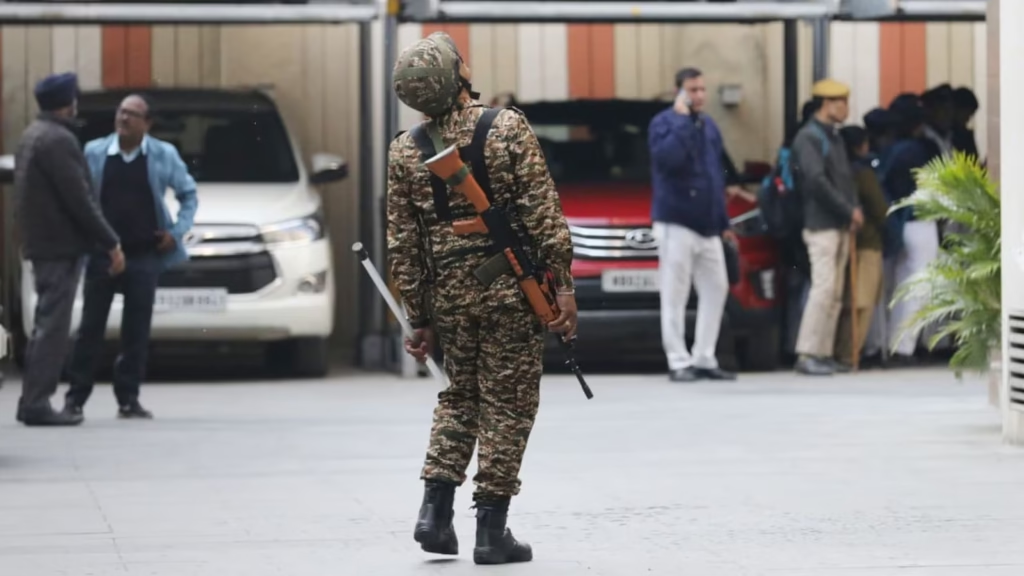
The family of Pratik Jain, co-founder and national chief of the Indian Political Action Committee (I-PAC), has filed a formal police complaint alleging theft of important documents during a prolonged search conducted by the Enforcement Directorate (ED) at his residence and office. The complaint, lodged hours after the agency concluded its operation, has added a fresh layer of controversy to an already politically sensitive investigation.
According to the complaint submitted at the local police station, members of Jain’s family alleged that several personal and professional documents were found missing after ED officials left the premises. The search operation, which began early in the morning, reportedly continued for close to nine hours, covering Jain’s residence as well as I-PAC’s office in Kolkata. Family members claimed that while they cooperated fully with the agency and did not obstruct the proceedings, they later discovered that certain documents not listed in the official seizure memo could not be located.
Police officials confirmed that the complaint had been received and entered into the station diary. They stated that the matter would be examined in accordance with the law and that preliminary verification would be carried out to determine the nature of the missing documents and whether they were part of the ED’s authorised seizure. Officers said that at this stage the complaint remains an allegation and no conclusion has been drawn.
The ED search was part of an ongoing money-laundering investigation linked to alleged irregularities in coal transportation and procurement in eastern India. While the agency has not publicly detailed the specific reasons for searching I-PAC-linked premises, officials familiar with the matter indicated that the probe involves tracing financial transactions and documents that may reveal how alleged proceeds of crime were routed through various entities. The agency maintains that all its searches are conducted under valid warrants and in the presence of witnesses, and that seized materials are properly inventoried.
I-PAC, founded in 2014, has emerged as one of India’s most influential political consulting organisations, having worked on multiple election campaigns across states. Pratik Jain, known for maintaining a relatively low public profile compared to some of the organisation’s other founders, has been involved in data-driven political strategy and organisational planning. The ED action against premises linked to such a high-profile consultancy has inevitably drawn political attention, particularly in West Bengal where I-PAC has worked closely with the ruling party in the past.
The search operation itself quickly became a public spectacle. Senior leaders of the ruling Trinamool Congress, including Chief Minister Mamata Banerjee, visited Jain’s residence during the day, sharply criticising the ED’s action and alleging political vendetta by central agencies. The presence of senior political figures during an ongoing central probe further escalated tensions, prompting heated exchanges between state leaders and the BJP, which defended the ED’s authority to investigate financial crimes.
Amid this charged atmosphere, the family’s theft allegation has shifted some focus from the substance of the money-laundering probe to the conduct of the search itself. In the complaint, Jain’s family reportedly stated that the missing documents included personal papers that were neither shown nor mentioned in the seizure list prepared by ED officials at the end of the raid. They demanded that the police investigate how these documents went missing and fix responsibility if any wrongdoing occurred.
Legal experts note that while central agencies such as the ED enjoy wide powers under the Prevention of Money Laundering Act, they are also bound by strict procedural safeguards. Every item seized during a search must be listed in a panchnama and acknowledged by the person from whose custody it is taken. If items not mentioned in the official record are later found missing, the affected party has the right to seek legal remedy, including a police inquiry or judicial intervention.
At the same time, experts caution that allegations made immediately after high-stakes searches must be carefully verified. “There are often disputes over what constitutes seized material and what remains on the premises,” said a senior criminal lawyer. “An investigation will need to compare the seizure memo, witness statements and the nature of the documents alleged to be missing before any conclusion can be drawn.”
The ED, for its part, has indicated that it will respond to the allegations through appropriate legal channels. Agency sources said that the search teams followed due process and that any claim of theft was “baseless and motivated.” Officials emphasised that ED officers operate under video recording and independent witnesses during searches, leaving little scope for unauthorised removal of documents.
Beyond the immediate legal questions, the episode underscores the growing friction between opposition-ruled states and central investigative agencies. Over the past few years, ED and CBI actions against political leaders, bureaucrats and organisations linked to opposition parties have frequently been criticised as selective and politically driven. The Union government has consistently rejected these claims, arguing that agencies are merely performing their statutory duties.
For I-PAC, the developments pose reputational challenges as well as operational ones. As a professional political consultancy, its credibility depends heavily on perceptions of neutrality and data integrity. Any prolonged association with criminal investigations, regardless of outcome, risks casting a shadow over its work. In statements issued after the raid, people close to the organisation said it would continue to cooperate with investigators while also pursuing all legal options to protect its rights.
Police officials said the next steps would include calling Jain’s family to record detailed statements, examining the list of seized items prepared by the ED, and, if required, seeking clarifications from the agency. Depending on the findings, the police could either close the complaint or recommend further action. Observers say the matter could eventually reach the courts if either side challenges the outcome of the police inquiry.
As of now, no arrests have been made in connection with the raid or the subsequent complaint. The ED’s money-laundering investigation continues, while the police inquiry into the alleged theft remains at a preliminary stage. With political tempers still high and legal processes underway, the case is likely to remain in the public eye in the coming days.
For the Jain family, the complaint represents an attempt to seek accountability and clarity after an intrusive search. For the ED, it is another test of credibility at a time when its actions are under intense scrutiny. And for the broader political landscape, the episode once again highlights how investigative actions and politics in India have become deeply intertwined, with each new development quickly turning into a flashpoint for debate and confrontation.
About the Author