Ukraine Peace Talks: Zelensky Proposes Demilitarised Zones to Ease Conflict
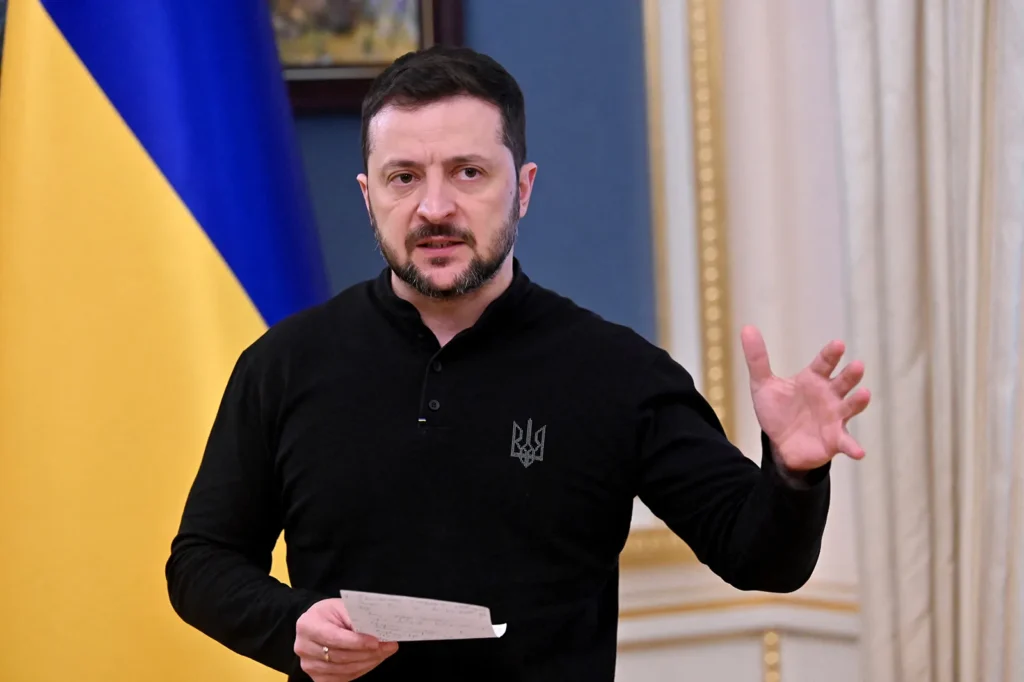
Ukrainian President Volodymyr Zelensky has outlined details of a revised peace proposal that could mark a significant shift in efforts to end the war with Russia, including the possible creation of demilitarised zones in eastern Ukraine and limited troop withdrawals under strict conditions.
Speaking to journalists, Zelensky said the updated 20-point peace framework, developed jointly by Ukrainian and U.S. envoys during talks in Florida over the weekend, is now awaiting a response from Moscow. He said Russia was expected to react after consultations with American officials.
Describing the proposal as the main framework for ending the war, Zelensky stressed that it seeks to balance compromise with Ukraine’s core red lines sovereignty, long-term security guarantees and full control over its territory.
A central element of the plan is a set of strong security guarantees for Ukraine, backed by the United States, NATO members and European partners. According to Zelensky, the framework envisions a coordinated military response if Russia were to invade Ukraine again, similar in principle to NATO’s collective defence commitments.
Ukraine would also be allowed to maintain a peacetime military force of up to 800,000 troops, ensuring the country retains the ability to defend itself even after a peace settlement.
The most sensitive part of the plan focuses on eastern Ukraine’s Donbas region, where fighting has been fiercest. Zelensky acknowledged that while Kyiv remains opposed to withdrawing from its own territory, negotiators are exploring alternative arrangements to reduce tensions.
One option under discussion is the creation of a demilitarised zone or a free economic zone in parts of the Donetsk region still held by Ukrainian forces. Under this scenario, Ukraine could pull back heavy weaponry by distances of five, 10 or even 40 kilometres, but only if Russian forces carried out equivalent withdrawals.
Zelensky stressed that any demilitarised or economic zone would remain under Ukrainian administration and law enforcement, with no role for Russian police or authorities. International forces would be deployed along the contact line to prevent infiltration and ensure compliance with the agreement.
Ukraine, he said, has not agreed to abandon territory. Instead, U.S. negotiators have been tasked with examining ways to reduce military confrontation while preserving Ukrainian sovereignty.
“There are two options,” Zelensky said. “Either the war continues, or difficult decisions will have to be made regarding potential economic or demilitarised zones.”
Russian forces currently stand about 40 kilometres east of Ukraine’s heavily fortified cities of Sloviansk and Kramatorsk after capturing the town of Siversk. Moscow has repeatedly demanded that Ukraine withdraw from nearly a quarter of the Donetsk region it still controls, a demand Kyiv has consistently rejected.
The new 20-point document is widely viewed as an update to an earlier 28-point proposal discussed weeks ago between U.S. envoy Steve Witkoff and Russian officials. That earlier draft was criticised in Ukraine and across Europe for appearing to favour Russian demands.
Zelensky said the revised version provides stronger security guarantees and greater clarity on territorial issues, although he admitted that full agreement has not yet been reached with U.S. negotiators.
Much of the updated framework reflects discussions held earlier in Berlin involving U.S., Ukrainian and European officials. Talks later moved to Miami, where the U.S. team met separately with Russian envoy Kirill Dmitriev and with Ukrainian and European representatives.
Despite the new proposals, Zelensky acknowledged that Russian President Vladimir Putin is unlikely to welcome the compromises being discussed. Putin has stated that Russia would seek to take control of all of eastern Ukraine by force if Ukrainian troops do not withdraw.
However, Zelensky believes Russia faces growing pressure from Washington to engage seriously. He said Moscow would struggle to openly reject a peace plan backed by the United States.
“If Russia tries to block everything, the response will be more weapons for Ukraine and stronger sanctions,” he said.
Any final peace agreement would require approval through a national referendum, Zelensky added, arguing that only a public vote could legitimise decisions on issues as sensitive as demilitarisation or economic zones.
The plan also includes provisions for holding elections in Ukraine as soon as possible after a deal is signed. Ukraine has been under martial law since the start of Russia’s full-scale invasion, making elections impossible under current conditions.
The framework further addresses the Zaporizhzhia nuclear power plant, currently occupied by Russian forces. Zelensky said any settlement would require the creation of a special economic zone around the plant and the withdrawal of Russian troops. He rejected a proposal for joint operation of the facility by Ukraine, Russia and the United States, insisting it must return to Ukrainian control.
In addition, the plan calls for Russian forces to withdraw from the Ukrainian regions of Dnipropetrovsk, Mykolaiv, Sumy and Kharkiv.
Beyond security issues, the proposal reaffirms Ukraine’s sovereignty and includes a non-aggression pact with Russia, backed by an international monitoring mechanism. It does not bar Ukraine from joining NATO, a key Russian demand that appeared in earlier drafts but has now been removed.
The plan also outlines a clear path for Ukraine to join the European Union, including a defined accession timeline, and proposes the creation of a $200 billion investment fund supported by the U.S. and Europe to help rebuild the country after years of war.
Despite the level of detail in the updated framework, major obstacles remain. Russia has rejected European proposals for international peacekeeping forces and continues to demand territorial concessions that Ukraine considers unacceptable.
Still, Zelensky described the proposal as a serious effort to end the war without sacrificing Ukraine’s independence.
As diplomats await Moscow’s response, the coming days could determine whether the plan becomes the basis for formal negotiations or another stalled attempt to bring an end to a conflict that has reshaped Europe’s security landscape.
About the Author