Australia Holds Candlelight Vigils, Observes Silence for Bondi Beach Shooting Victims
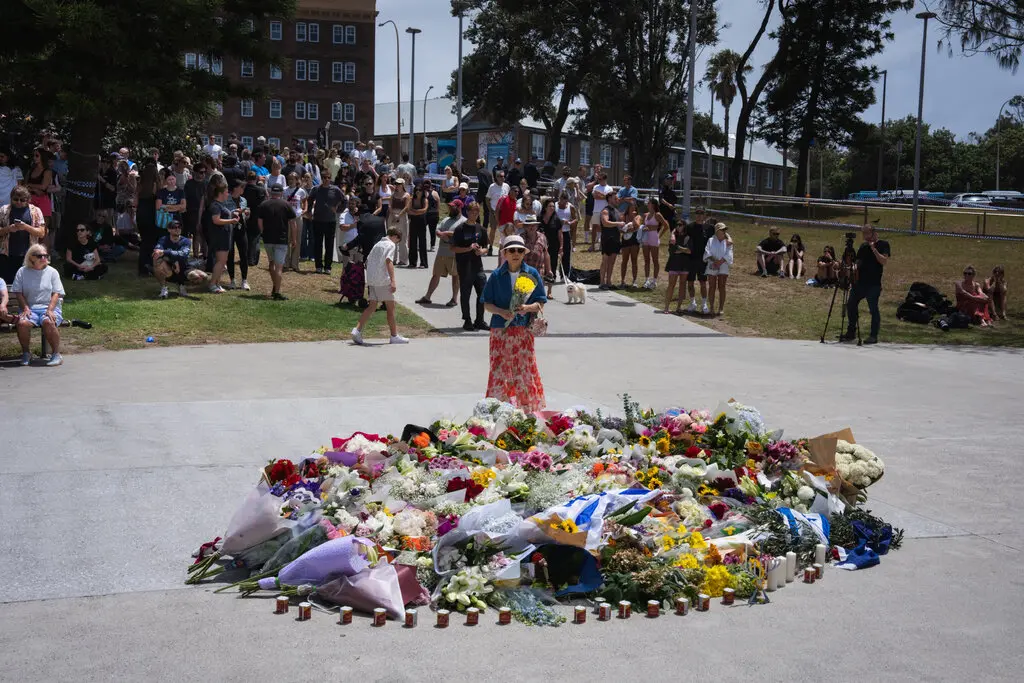
Australians came together in quiet remembrance on Sunday evening, lighting candles and observing a nationwide moment of silence to honour the victims of the Bondi Beach shooting, exactly one week after the country was shaken by one of its deadliest acts of mass violence in decades.
At 6:47 pm local time, the moment when the first reports of gunfire emerged a week earlier, cities and towns across Australia paused. From bustling urban centres to small rural communities, people stood still in homes, public spaces and places of worship, many placing candles on windowsills in a symbolic gesture of “light over darkness”.
The attack, which occurred during a Hanukkah celebration at Sydney’s iconic Bondi Beach, claimed the lives of 15 people, including children and elderly Holocaust survivors. Authorities have charged a father and son with carrying out the assault, describing it as an antisemitic act of terrorism that has left deep scars on the nation’s collective conscience.
At Bondi Beach itself, thousands gathered for a candlelight vigil under cloudy skies. Flags flew at half-mast across the country, including atop the Sydney Harbour Bridge, as summer winds swept through the beachfront memorial. A single candle was lit before the crowd fell into silence, many holding hands or embracing strangers.
“We’re here together,” said Roslyn Fishall, a member of Sydney’s Jewish community, speaking softly at the makeshift memorial. “Turn to strangers, hug them, and let’s try to make peace together,” she urged, reflecting the mood of unity and grief that marked the evening.
Yet alongside sorrow, anger and frustration were also evident. Some members of the crowd voiced displeasure at what they see as the government’s slow response to a rise in antisemitic incidents in recent years. When Prime Minister Anthony Albanese’s presence at the vigil was announced, scattered boos were heard, underscoring the depth of public emotion.
David Ossip, president of the New South Wales Jewish Board of Deputies, delivered a somber message. “Last week took away our innocence,” he said. “Just as the grass here at Bondi was stained with blood, so too has our nation been marked forever.” He added that the tragedy was made worse by the fact that warning signs had existed. “How much more painful is it when lives are lost despite clear signals that something was wrong?”
For decades, Australians have taken comfort in the belief that mass shootings were largely a thing of the past, following strict gun control laws enacted after the 1996 Port Arthur massacre. That sense of security was shattered when gunfire erupted on one of the country’s most famous beaches. The sound was so unexpected that many initially mistook it for fireworks before chaos unfolded.
In the days since, grief has rippled across the nation. Families have buried loved ones, and communities have moved from one funeral to another. Among the victims was 10-year-old Matilda, the youngest killed in the attack. Her parents, Michael and Valentyna, migrants from Ukraine, named her after “Waltzing Matilda,” one of Australia’s most beloved folk songs. Mourners wept openly as she was laid to rest.
“The loss is beyond words,” said Rabbi Levi Wolff. “It’s the kind of pain that changes people forever.”
Authorities have said the alleged attackers were inspired by extremist ideology linked to the Islamic State group. Investigators are treating the shooting as a terrorist act motivated by antisemitism, a development that has raised fears about social cohesion in Australia’s multicultural society.
Tensions have risen in the aftermath of the attack. Reports of hate crimes have surfaced, including the desecration of Muslim graves, while some far-right groups have organised new anti-immigration protests. Jewish community leaders have accused the government of failing to adequately address what they describe as a growing tide of antisemitism.
“Do we feel safe? Honestly, not really,” said Rabbi Yossi Friedman at a floral memorial for the victims. “That fear is now part of daily life.”
Questions are also being asked about how the suspects were able to carry out the attack. One of the accused had reportedly been flagged by Australia’s intelligence agency several years ago but was later assessed as posing no immediate threat. Critics are demanding answers about whether warning signs were missed and how monitoring systems failed.
In response, the federal government has announced a series of measures aimed at tightening gun laws and strengthening penalties for hate speech. Prime Minister Albanese unveiled a sweeping national gun buyback scheme, describing it as necessary to “get guns off our streets.” It is the most significant buyback initiative since the reforms introduced after Port Arthur nearly three decades ago.
A counter-terrorism task force is now investigating the suspects’ overseas travel, including a trip to the southern Philippines weeks before the attack. The Prime Minister has also ordered a comprehensive review of police and intelligence operations to determine whether changes are needed to prevent similar tragedies.
Amid the horror, stories of extraordinary bravery have emerged. Unarmed beachgoers reportedly confronted the attackers, while others shielded strangers or ran through gunfire to help the wounded. One of the victims, 87-year-old Holocaust survivor Alex Kleytman, was killed while protecting his wife.
Another widely praised act involved Ahmed al Ahmed, a shopkeeper and father of two who migrated to Australia from Syria nearly a decade ago. Witnesses say he dodged between cars before wrestling a weapon from one of the attackers, an act many have hailed as heroic.
One of the alleged gunmen was shot dead by police at the scene. The second remains hospitalised under guard and faces multiple charges, including terrorism and murder.
As candles burned across the country on Sunday night, Australians reflected not only on the lives lost but also on the values of unity, courage and resilience. The silence that fell at 6:47 pm was heavy with grief, but it also carried a shared determination that such a tragedy must never be repeated.
About the Author