Nitish Kumar’s Rajya Sabha Move Signals End of Long Bihar Era, Spotlight on Possibility of State’s First BJP Chief Minister
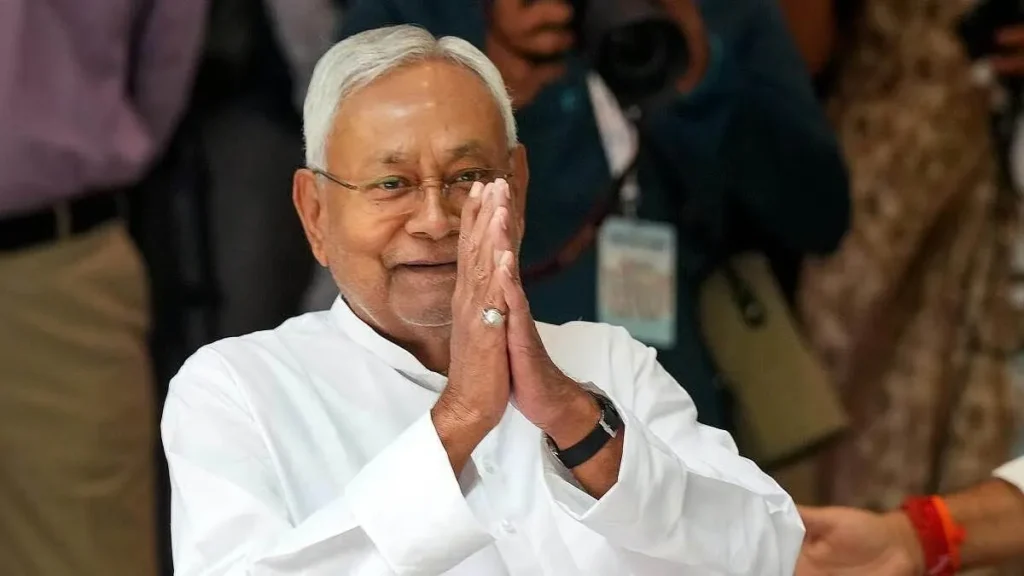
Patna: Bihar politics may be on the cusp of a major transition as Chief Minister Nitish Kumar prepares to move to the Rajya Sabha, potentially bringing to a close one of the longest chief ministerial tenures in the state’s history and triggering intense speculation over who will lead the government next.
For nearly two decades, Nitish Kumar has been the central figure in Bihar’s political landscape. First assuming office in 2005, the leader of the Janata Dal (United) went on to take oath as chief minister multiple times across different political alignments, shaping the state’s governance and political narrative for almost twenty years.
His tenure is often associated with efforts to restore law and order, improve infrastructure and expand welfare programmes. When Kumar first came to power, Bihar was grappling with high crime rates and poor infrastructure. His government pushed measures such as fast-track courts to deal with criminal cases, recruitment drives in the police force, and large-scale road construction projects aimed at improving connectivity across districts.
Nitish Kumar also introduced several social welfare initiatives, including schemes encouraging girls’ education and policies promoting women’s participation in local governance. Reservation for women in panchayats and urban local bodies became one of the hallmark reforms during his administration, widely credited with increasing women’s representation in grassroots politics.
At the same time, Kumar’s political career has been marked by frequent alliance shifts, moving between the Bharatiya Janata Party-led National Democratic Alliance and opposition coalitions at different points over the years. These shifts often reshaped Bihar’s political equations but also ensured Kumar remained the dominant figure in the state’s leadership.
His possible move to the Rajya Sabha is therefore being viewed as a turning point. If he vacates the chief minister’s post, it would open the door for a new leadership arrangement within the ruling NDA in Bihar.
Political observers say the development could potentially allow the BJP to lead the Bihar government directly for the first time in the state’s recent coalition era. Despite being a major partner in multiple governments in Bihar, the BJP has so far supported Nitish Kumar as the face of the administration.
Several BJP leaders are being discussed as possible successors should the party decide to claim the chief minister’s post. Among the names circulating in political circles are senior party leaders such as Samrat Choudhary, Vijay Kumar Sinhaand Nityanand Rai. The final decision, however, is expected to depend on internal party consultations as well as the broader power-sharing arrangement within the NDA.
There is also speculation that the JD(U) could seek to retain the chief minister’s post if the alliance decides to maintain the existing balance of power. In such a scenario, a senior JD(U) leader could emerge as a consensus candidate, although no official announcement has been made.
For Bihar, the moment marks a possible end of the political era defined by Nitish Kumar’s leadership since 2005. His governance style, coalition maneuvering and administrative reforms have left a deep imprint on the state’s politics.
Whether the transition leads to Bihar’s first BJP chief minister or another compromise formula within the NDA, the coming weeks are likely to reshape the state’s political trajectory ahead of the next phase of electoral politics.
About the Author