Supreme Court puts interim hold on new UGC rules addressing caste-based discrimination
New Delhi: The Supreme Court on Thursday stayed the implementation of newly notified University Grants Commission (UGC) regulations aimed at addressing caste-based discrimination in higher educational institutions, citing serious concerns over vagueness, lack of definitional clarity and the potential for misuse. The top court ordered that the earlier 2012 framework governing complaints of discrimination on campuses will continue to operate until further directions.
A three-judge Bench of the Supreme Court of India, headed by the Chief Justice of India, passed the interim order while hearing a batch of petitions challenging the Promotion of Equity in Higher Education Institutions Regulations, 2026, notified by the University Grants Commission earlier this month.
The court also issued notices to the Union Ministry of Education and the UGC, seeking detailed responses on the drafting, intent and safeguards built into the regulations. The matter has been listed for further hearing after the respondents file their affidavits.
What the new regulations sought to introduce
The 2026 regulations were framed with the stated objective of strengthening institutional mechanisms to prevent caste-based discrimination, exclusion and harassment in universities and colleges. Among other provisions, the rules mandated the setting up of Equal Opportunity Centres, appointment of an Ombudsperson, constitution of Equity Committees, and a structured complaint-redress mechanism with defined timelines.
The regulations attempted to widen the scope of institutional responsibility by placing explicit obligations on higher education institutions to ensure an inclusive campus environment, monitor patterns of discrimination and impose penalties in cases of proven violations. The UGC described the framework as an effort to move from “formal equality” to “substantive equity” within India’s higher education system.
Why the regulations were challenged
Soon after the notification, multiple petitions were filed before the Supreme Court by teachers, students, parents and civil society groups. The petitioners argued that the regulations, though well-intentioned, were drafted in imprecise terms and could have far-reaching consequences for academic freedom, free expression and due process on campuses.
A key point of challenge was the definition of “caste-based discrimination” under the regulations. Petitioners contended that the language was overly broad and subjective, potentially allowing ordinary academic disagreements, personal conflicts or disciplinary actions to be recast as discriminatory conduct without adequate safeguards.
The petitions also questioned the absence of clear procedural protections for those accused of misconduct, including standards of proof, appellate remedies and safeguards against frivolous or malicious complaints. According to the challengers, the regulations conferred excessive discretionary power on institutional committees without sufficient checks.
Supreme Court’s observations
During the hearing, the Bench indicated that while the objective of eliminating caste-based discrimination is constitutionally sound and socially necessary, regulatory measures must be framed with precision. The court observed that vague or open-ended definitions in subordinate legislation can create uncertainty and may lead to arbitrary outcomes.
The judges noted that prima facie, certain provisions of the 2026 regulations appeared capable of multiple interpretations, which could have “serious and unintended consequences” for students and faculty members alike. Emphasising the need for clarity in rules that affect fundamental rights, the court held that an interim stay was warranted until the issues raised were examined in detail.
As an interim arrangement, the court directed that the UGC’s 2012 regulations dealing with prevention of discrimination and grievance redressal would continue to apply across institutions.
Reactions from stakeholders
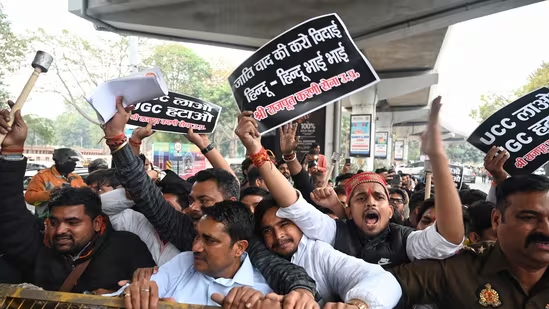
The Supreme Court’s decision triggered sharp and divided reactions. Several student bodies and academic associations welcomed the stay, arguing that poorly drafted rules could undermine trust on campuses and expose individuals to reputational harm without adequate procedural fairness.
“These regulations needed wider consultation and tighter drafting. The court has rightly paused their implementation,” said a senior university professor who is a petitioner in the case.
On the other hand, organisations representing marginalised communities expressed concern that the stay could delay urgently needed protections for students from historically disadvantaged backgrounds. They argued that existing mechanisms under the 2012 framework have often proved inadequate in addressing subtle and structural forms of caste-based exclusion.
Some student groups also pointed out that complaints of discrimination frequently go unaddressed due to institutional apathy, and warned that halting the new framework without offering an immediate alternative could reinforce existing power imbalances on campuses.
Government and UGC response
Officials from the Ministry of Education and the UGC maintained that the intent behind the 2026 regulations was to strengthen, not dilute, safeguards against caste-based discrimination. Government sources indicated that the rules were framed after internal deliberations and were meant to align institutional practices with constitutional values of equality and dignity.
The Centre is expected to file a detailed affidavit before the Supreme Court explaining the rationale behind the drafting choices, the consultation process undertaken, and the safeguards envisaged to prevent misuse. Legal sources said the government may also indicate its willingness to revisit or clarify certain provisions if directed by the court.
Broader legal and policy implications
Legal experts say the case raises important questions about the limits of regulatory rule-making in sensitive social domains. While the UGC has the statutory authority to frame regulations for higher education institutions, courts have consistently held that such rules must meet standards of clarity, proportionality and procedural fairness.
The Supreme Court’s intervention underscores the judiciary’s role in balancing competing constitutional interests the need to protect vulnerable groups from discrimination on the one hand, and the need to safeguard due process and individual rights on the other.
Observers note that the outcome of the case could shape how future social-justice-oriented regulations are drafted, particularly in sectors such as education where regulatory action directly affects everyday interactions and professional trajectories.
What happens next
With the stay in place, universities and colleges across the country will continue to follow the 2012 grievance-redress framework until further orders. Institutions that had begun preparatory steps to implement the new regulations may now pause those efforts.
The Supreme Court is expected to examine whether the 2026 regulations require redrafting, clearer definitions, additional procedural safeguards, or a more comprehensive legislative framework enacted by Parliament.
As the case proceeds, it is likely to remain at the centre of a broader national debate on how best to address caste-based discrimination in higher education while ensuring fairness, clarity and accountability in regulatory governance.
About the Author