Why Mamata Banerjee has hit out at EC over ‘sweeping’, ‘unilateral’ transfers of officials
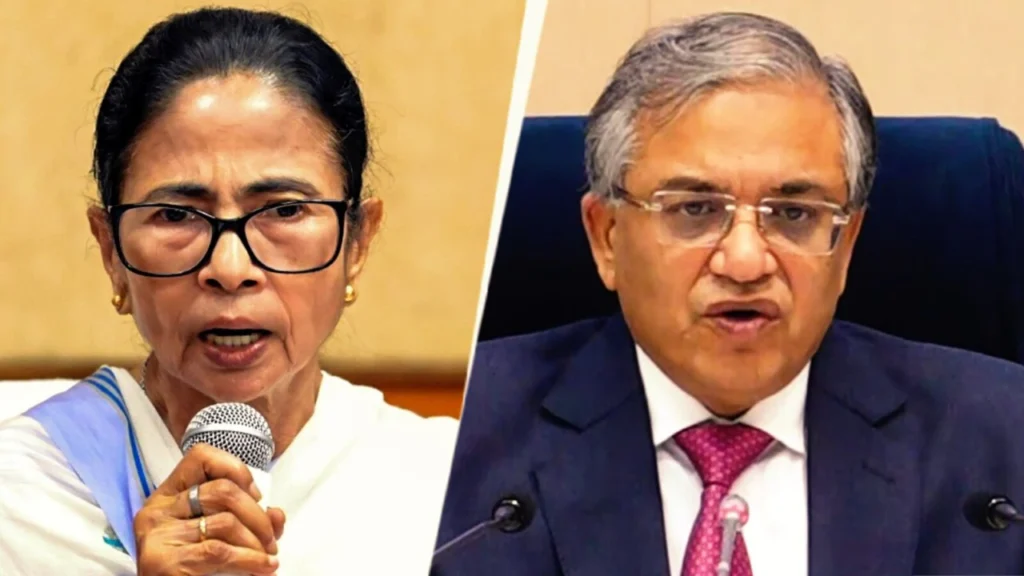
A fresh confrontation has erupted between the West Bengal government and the Election Commission (EC), with Chief Minister Mamata Banerjee accusing the poll body of carrying out “sweeping” and “unilateral” transfers of state officials ahead of elections. The Trinamool Congress (TMC) chief has alleged that the scale and manner of these changes raise concerns about administrative neutrality and federal balance, even as the EC maintains that such steps are routine and aimed at ensuring free and fair polls.
The controversy centres on the EC’s recent orders transferring several senior bureaucrats, including district magistrates, police superintendents and other key administrative personnel. The Commission has not publicly detailed each decision but indicated that the reshuffle is part of its standard pre-election exercise to prevent local influence, conflicts of interest or partisan bias.
Banerjee, however, has questioned both the intent and process. She has argued that the transfers were carried out without adequate consultation with the state government and described them as excessive in scope. According to her, the removal of multiple officials in one go disrupts governance and undermines the authority of an elected state administration. She has also suggested that some officers were targeted arbitrarily, a charge the EC has not responded to directly.
The EC’s authority to transfer or remove officials during elections is well established. Under Article 324 of the Constitution, the Commission is vested with the power of “superintendence, direction and control” of elections. This has been interpreted by courts to include the ability to deploy, transfer or discipline officials involved in election-related duties to maintain neutrality.
In addition, the Model Code of Conduct (MCC), which comes into force once elections are announced, restricts governments from making transfers of officials directly connected with election work without the EC’s approval. The Commission often orders the relocation of officers who have served in a district for an extended period or those perceived to have close links with political actors. Typically, officers posted in their home districts or those who have completed a certain tenure are moved out as a preventive measure.
This practice is not new. In previous elections across states, the EC has routinely ordered large-scale reshuffles of administrative and police officials to minimise the possibility of bias. Such actions have occasionally triggered political pushback, particularly from ruling parties that view the transfers as disruptive or selective.
In West Bengal, a politically sensitive state with a history of intense electoral contests, the issue has frequently surfaced in past polls. Opposition parties have often demanded stricter oversight by the EC, alleging partisan use of the state machinery, while the ruling TMC has countered that central intervention sometimes overreaches.
Banerjee’s latest criticism appears to reflect this broader tension. She has contended that while the EC has constitutional powers, those powers must be exercised transparently and with due regard to the federal structure. The state government, she has said, is not opposed to ensuring fair elections but objects to what it sees as excessive interference.
The EC, on its part, is unlikely to roll back the transfers, given its consistent position that administrative reshuffles are essential to maintaining electoral integrity. Officials moved out are typically replaced by officers considered neutral or drawn from outside their home districts.
As the state heads toward elections, the episode underscores the recurring friction between elected governments and the poll watchdog over the extent of its authority. While the law largely backs the EC’s powers, the political debate over their application continues to shape the pre-election landscape.
About the Author