Maharashtra BJP chief apologises to ex-CM Deshmukh’s son after “memories will be deleted” remark
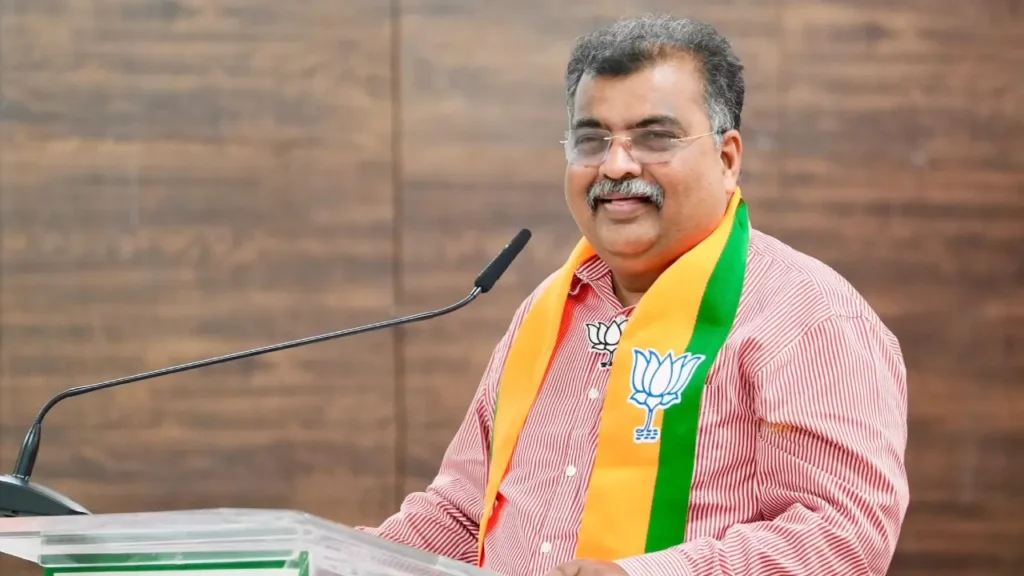
Politics in Maharashtra witnessed a rare but telling moment of public contrition when the state BJP president Ravindra Chavan apologised to Riteish Deshmukh, son of late former chief minister Vilasrao Deshmukh, after a controversial remark made during a political meeting in Latur. What began as a charged campaign statement soon transformed into a wider conversation about political decency, respect for public memory, and the thin line between aggressive rhetoric and personal hurt.
The controversy erupted during a BJP gathering in Latur, the home turf of Vilasrao Deshmukh and a region deeply associated with his political journey. Addressing party workers and supporters ahead of local body elections, Ravindra Chavan used the phrase that the “memories” of Vilasrao Deshmukh would be “deleted” from Latur. For many residents of Latur and supporters of the Congress, the words were seen as dismissive and disrespectful toward a leader who had shaped the political and social landscape of the region for decades.
Vilasrao Deshmukh was not just a former chief minister; for many in Latur, he symbolised aspiration, regional pride, and political accessibility. His rise from grassroots politics to occupying the top post in Maharashtra twice made him a towering figure in the Marathwada region. Even years after his death, his name continues to evoke emotional loyalty. Against this backdrop, the suggestion that his memory could be “erased” was bound to provoke strong reactions.
The immediate backlash was swift. Congress leaders accused the BJP of indulging in political arrogance and of attempting to insult the legacy of a respected mass leader. Social media amplified the controversy, with many users calling the remark insensitive and unnecessary. What might otherwise have remained a fleeting campaign statement became a headline-grabbing issue, forcing the BJP leadership into damage-control mode.
Sensing the growing outrage, Ravindra Chavan moved quickly to clarify his position. In a public statement, he expressed regret over the remark and apologised directly to Riteish Deshmukh if his words had caused pain. Chavan insisted that his comment was not meant as a personal attack or an attempt to undermine Vilasrao Deshmukh’s contributions. According to him, the intention was to emphasise political change and electoral competition, not to hurt sentiments connected to a departed leader.
Riteish Deshmukh’s response to the apology was equally noteworthy. Known primarily as a film actor, Riteish has in recent years become more vocal on political and public issues, particularly when they intersect with his father’s legacy. Responding to the controversy, he spoke with a mix of restraint and emotion. Rather than escalating the confrontation, he emphasised that memories of leaders who served the people cannot be deleted by political statements.
In his reply, Riteish underscored that public memory is shaped by lived experiences, not by slogans or election speeches. Roads built, institutions created, and bonds formed with citizens endure far longer than campaign rhetoric, he suggested. His words resonated with many who saw his response as dignified and rooted in respect, rather than partisan anger. While he acknowledged the apology, his broader message was clear: political competition should not come at the cost of human sensitivity.
The exchange between Chavan and Riteish Deshmukh opened up a broader debate on the nature of political discourse in India. In recent years, election campaigns across states have grown increasingly combative, with sharp personal remarks often replacing substantive discussions on governance. While such language may energise party workers, it also risks alienating voters who value civility and respect for public figures, especially those no longer alive to defend themselves.
In Maharashtra, where political legacies often pass through generations, respect for predecessors carries special weight. Families like the Deshmukhs are not merely political entities; they are part of the region’s social fabric. Any perceived slight against them can quickly transform into a larger emotional issue. Political observers note that this is why the BJP leadership acted swiftly to contain the fallout, recognising that prolonged controversy could overshadow its campaign narrative.
For the Congress, the episode offered an opportunity to rally supporters and remind voters of Vilasrao Deshmukh’s enduring influence. Party leaders framed the remark as emblematic of what they described as the BJP’s disregard for regional icons. Even though the apology softened the immediate impact, the Congress continued to highlight the incident as a cautionary tale about the dangers of abrasive political language.
Beyond party politics, the incident also raised questions about how societies remember their leaders. Can a political legacy truly be erased, or does it persist through stories, institutions, and collective memory? Riteish Deshmukh’s response leaned firmly toward the latter view. By personalising the issue without turning it into a bitter exchange, he tapped into a sentiment shared by many Indians: that respect for the dead transcends political rivalry.
The timing of the controversy was also crucial. With civic elections approaching, every word spoken by senior leaders is scrutinised for its potential impact on voter mood. In such a sensitive environment, even a single sentence can alter the tone of the campaign. Chavan’s apology, therefore, was as much a political calculation as it was a gesture of remorse.
As the dust settles, the episode is likely to be remembered less for the original remark and more for the responses it generated. It showcased a rare moment where political accountability, public sentiment, and personal dignity intersected. While aggressive rhetoric remains a staple of Indian elections, incidents like this serve as reminders that voters are attentive not just to what leaders promise, but also to how they speak.
In the larger scheme of Maharashtra politics, the controversy may not drastically alter electoral outcomes. Yet it has reinforced an important lesson: political change cannot be built on the erasure of memory. Leaders may come and go, parties may rise and fall, but the imprint left by those who governed with mass support continues to shape public consciousness.
Ultimately, the apology by Ravindra Chavan and the measured reply by Riteish Deshmukh reflect two different but complementary impulses in public life the need to correct a misstep, and the need to defend dignity without fuelling division. In an era of loud politics, that balance itself stands out.
About the Author