Is the Left left out in this Bengal election?
Left Front Political Rally Bengal Decline
As West Bengal heads towards another crucial Assembly election, the Left Front once the state’s most formidable political force finds itself on the fringes of the electoral battlefield. Reduced from a 34 year ruling bloc to an outfit struggling for survival, the Left’s decline is both steep and instructive, reflecting shifts in voter priorities, political strategy, and organisational strength.
A legacy of uninterrupted rule
The Left Front, led primarily by the Communist Party of India (Marxist), governed West Bengal continuously from 1977 to 2011. This long tenure was built on a strong rural base, land reforms, and a disciplined cadre structure. Policies such as land redistribution and the empowerment of panchayats created a loyal support base among farmers and the working class.
Leaders like Jyoti Basu and later Buddhadeb Bhattacharjee provided stability and continuity, making the Left synonymous with governance in Bengal for over three decades. The Front’s ideological clarity and grassroots presence helped it dominate elections repeatedly, often with comfortable majorities.
Electoral trajectory: From dominance to wipeout
The Left’s electoral decline has been gradual but relentless.
In 2011, the Left Front lost power to the Trinamool Congress (TMC), ending its historic rule. Despite the defeat, it retained a substantial vote share and a sizeable presence in the Assembly, indicating that its base had not entirely eroded.
By 2016, the situation had worsened. The Left entered into an alliance with the Congress in a bid to counter the TMC. While the alliance improved arithmetic on paper, it failed to inspire voters. The Left’s seat tally dropped sharply, and its vote share declined significantly.
The real blow came in 2021, when the Left failed to win a single seat in the Assembly an unprecedented outcome in Bengal’s political history. From being the principal opposition, it was reduced to complete legislative irrelevance.
The decline has also been visible in parliamentary elections, where the Left’s vote share has steadily shrunk, and its representation has nearly vanished.
Rise of a bipolar contest
One of the key reasons behind the Left’s marginalisation has been the emergence of a bipolar political contest in West Bengal.
The Trinamool Congress consolidated its position as the dominant regional force, particularly among rural and minority voters. At the same time, the Bharatiya Janata Party (BJP) expanded rapidly, positioning itself as the principal challenger to the TMC.
This shift effectively squeezed the Left out of the political space. Elections that once saw multi-cornered contests are now largely direct battles between the TMC and the BJP, leaving little room for a third force to gain traction.
What went wrong for the Left?
Political observers point to several interlinked factors behind the Left’s decline:
1. Alienation of rural voters
The Singur and Nandigram movements marked a turning point. The Left government’s push for industrialisation, involving land acquisition, triggered widespread protests. Farmers and rural communities once the backbone of Left support began to feel alienated.
This loss of trust proved costly, as many of these voters shifted allegiance to the TMC.
2. Organisational erosion
The Left’s strength historically lay in its cadre-based structure. However, after losing power in 2011, the organisation weakened. Local networks deteriorated, party offices became inactive in several areas, and mobilisation capacity declined.
In contrast, both the TMC and BJP built aggressive grassroots machinery, further sidelining the Left.
3. Ageing leadership and lack of renewal
The party has struggled to project new leadership that resonates with younger voters. While efforts have been made to bring in youth faces, they have not yet translated into electoral gains.
A perception persists that the Left has not adapted quickly enough to changing political realities.
4. Ideological confusion
The decision to ally with the Congress historically a rival created confusion among core supporters. Many voters found it difficult to reconcile the Left’s traditional ideological stance with such alliances.
This blurred identity weakened its appeal, particularly among committed supporters.
5. Shift in voter priorities
Bengal’s electorate has evolved. Welfare schemes, identity politics, and strong leadership narratives have gained prominence. The TMC’s welfare-driven governance and the BJP’s nationalistic appeal have both struck chords with different sections of voters.
The Left’s class-based politics, while still relevant, has struggled to compete with these newer narratives.
6. Polarisation of votes
The increasing polarisation between the TMC and BJP has led to consolidation of votes at both ends. Minority voters, wary of the BJP, have largely rallied behind the TMC, while a section of Hindu voters has shifted towards the BJP.
This has left the Left with a shrinking and fragmented voter base.
The current scenario
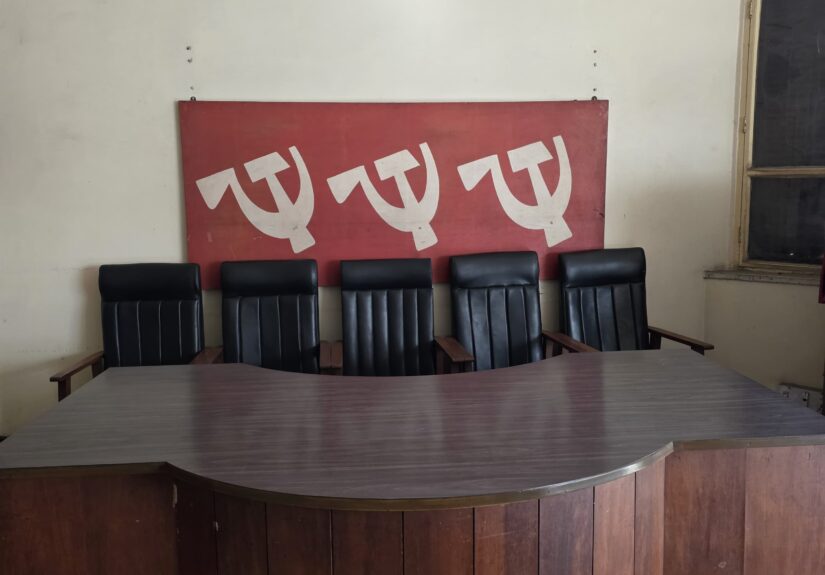
As the state approaches the next election, the Left faces a stark challenge: rebuilding from near-zero representation. Its absence from the Assembly has reduced its visibility, and limited electoral success has affected morale within the ranks.
The party has been attempting to revive its base through student movements, labour protests, and grassroots campaigns. It has also tried to reconnect with issues such as unemployment, price rise, and workers’ rights.
However, these efforts have yet to translate into significant electoral momentum.
Is there a path to revival?
A comeback for the Left in Bengal is not impossible, but it requires long-term structural rebuilding rather than short-term electoral strategies.
Key areas for revival include:
- Rebuilding grassroots networks: Strengthening local committees and reconnecting with rural voters
- Leadership renewal: Promoting younger leaders who can communicate effectively with new-age voters
- Clear ideological positioning: Reasserting its identity while adapting to contemporary issues
- Issue-based politics: Focusing on unemployment, economic distress, and governance gaps
The Left’s historical legacy still carries weight, particularly among older voters and sections of the working class. Whether it can convert this residual goodwill into electoral gains remains uncertain.
Conclusion
The decline of the Left Front in West Bengal represents a profound political transformation. From a dominant ruling force to an almost invisible player, its journey underscores the importance of adaptability, organisational strength, and voter connect.
As Bengal gears up for another electoral contest, the Left’s role may be limited, but its future will depend on how effectively it can reinvent itself. The upcoming election may not restore its past glory, but it could determine whether the Left remains a relevant force in Bengal’s political landscape or fades further into the margins.
About the Author