Khaleda Zia Legacy: Bangladesh’s First Woman PM, Fierce Rival of Sheikh Hasina, and a Towering Political Figure
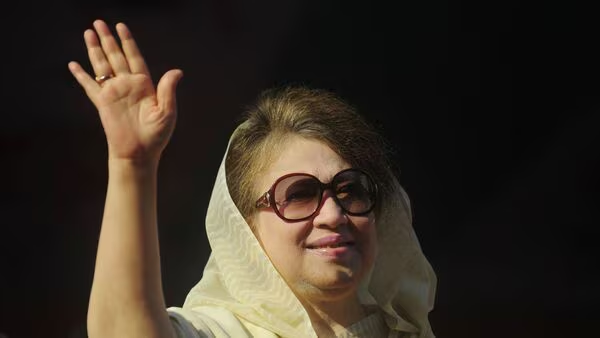
Bangladesh’s first woman prime minister Khaleda Zia, a central figure in the country’s political landscape for more than three decades, passed away on Tuesday at the age of 80. Alongside her long-time rival Sheikh Hasina, Khaleda Zia defined Bangladesh’s politics through fierce competition, shifting alliances, and contrasting visions for the nation’s future.
The Khaleda Zia legacy is marked by historic achievements, deep controversies, and an enduring influence on Bangladesh’s democracy, foreign relations, and party politics.
From First Lady to Political Powerhouse
Born into public life through her marriage to Ziaur Rahman, a former army chief who became President of Bangladesh in 1977, Khaleda Zia initially played the role of First Lady. Her life took a dramatic turn after Ziaur Rahman was assassinated in 1981.
With no prior political background, Khaleda Zia entered politics and took charge of the Bangladesh Nationalist Party (BNP) in 1984. What followed was a remarkable transformation from a political novice to a mass leader capable of mobilising millions.
Leading the Fight Against Military Rule
One of the defining chapters of the Khaleda Zia legacy was her leadership in the movement against General Hussain Muhammad Ershad’s military regime, which ruled Bangladesh after seizing power in 1982.
For nearly eight years, Khaleda Zia led street protests demanding the restoration of democracy. In a rare moment of unity, she joined hands with her political rival Sheikh Hasina in 1990 to oust the military ruler an alliance that ultimately reshaped Bangladesh’s democratic trajectory.
Soon after, their rivalry resumed and became famously known as the “Battle of the Begums”, a political duel that dominated Bangladesh for decades.
First Woman Prime Minister and Key Reforms
Khaleda Zia won the 1991 general elections and became Bangladesh’s first woman prime minister. During her first term (1991–1996), she oversaw major structural changes, including:
Transition from a presidential to a parliamentary system,
Introduction of Value Added Tax (VAT),
Free secondary education for girls in rural areas,
Institutionalisation of the caretaker government system for fair elections,
These reforms cemented her position as a transformative leader, particularly in strengthening democratic institutions and social welfare.
Complicated Relationship with India
The Khaleda Zia legacy also includes a complex and often strained relationship with India. During her two terms in office, she interacted with three Indian prime ministers and navigated sensitive regional issues.
Her second tenure (2001–2006) proved especially difficult for bilateral ties. During this period, India accused Bangladesh of allowing anti-India insurgent and extremist groups to operate freely, particularly after the BNP formed an alliance with the Islamist party Jamaat-e-Islami.
These developments led to a cooling of relations, while India later welcomed Sheikh Hasina’s return to power in 2008 due to her crackdown on cross-border militancy.
Responding to Regional Communal Tensions
Khaleda Zia governed Bangladesh during sensitive moments in India’s internal politics, including the Babri Masjid demolition in 1992 and the Gujarat riots in 2002.
She maintained that her government took firm steps to prevent communal unrest in Bangladesh, including restricting inflammatory media coverage and ensuring protection for minority communities an aspect she later highlighted in interactions with Indian leaders.
Controversies and Political Setbacks
Despite her achievements, the Khaleda Zia legacy is also shaped by controversy. Allegations emerged that her government between 2001 and 2006 was heavily influenced by her son Tarique Rahman, with power allegedly operating from the infamous Hawa Bhaban.
Her most damaging political decision came in 2013, when the BNP boycotted elections over the caretaker government issue. Analysts widely describe this move as a strategic miscalculation that allowed Sheikh Hasina to consolidate power in subsequent years.
Imprisonment and Declining Health
From 2014 onwards, Khaleda Zia and the BNP faced sustained pressure. In 2018, she was jailed on corruption charges related to the Zia Orphanage Trust and later confined to her home following a conditional release during the Covid-19 pandemic.
Her health deteriorated steadily, limiting her public presence but not her symbolic importance within the BNP.
Final Years and Political Legacy
Following the collapse of Sheikh Hasina’s government amid mass protests in 2024, Khaleda Zia urged political reconciliation, calling for an end to the “politics of vengeance.”
As Bangladesh looks ahead to elections expected in 2026, the BNP appears poised for a comeback under the leadership of her son, Tarique Rahman making Khaleda Zia’s reflections on political legacy and public acceptance especially relevant.
A Contested but Enduring Legacy
The Khaleda Zia legacy remains deeply contested. To supporters, she was a champion of democracy and a trailblazer for women in politics. To critics, her tenure was marred by polarisation and missed opportunities.
Yet few can deny her lasting impact. As Bangladesh enters a new political phase, Khaleda Zia’s life story continues to shape the nation’s debate on power, democracy, and leadership.
About the Author