Timeline | Indian Political Leaders Killed in Aviation Accidents
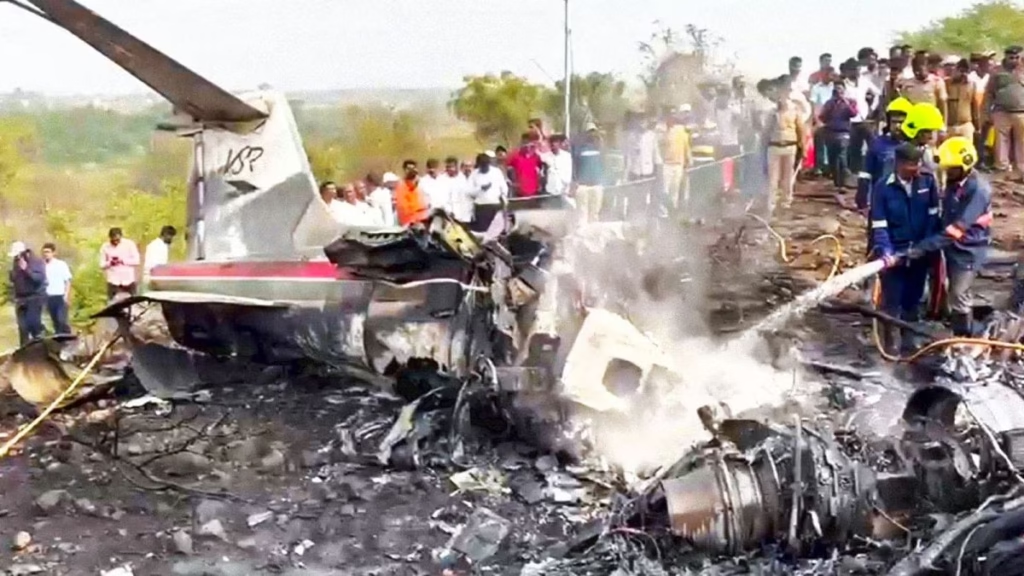
New Delhi — Aviation has long been a critical mode of transport for India’s political leadership, enabling rapid movement across the country’s vast and diverse geography. However, the reliance on aircraft and helicopters has also exposed leaders to significant risk. Over the decades, several prominent Indian political figures have lost their lives in air crashes while on official, political, or personal travel. The following timeline documents major such incidents that left a lasting impact on India’s political landscape.
June 23, 1980 — Sanjay Gandhi
Sanjay Gandhi, a key Congress leader and the younger son of Prime Minister Indira Gandhi, died at the age of 33 when the light aircraft he was piloting crashed shortly after takeoff near Safdarjung Airport in New Delhi. Gandhi, who held no formal government position at the time but wielded considerable influence within the ruling party, was flying a Pitts Special aerobatic aircraft when it lost control and plunged to the ground.
His sudden death sent shockwaves through the political establishment and marked a turning point for the Congress party. Sanjay Gandhi had emerged as a central figure during the Emergency period of 1975–77, and his absence reshaped succession dynamics within the party, eventually paving the way for his elder brother Rajiv Gandhi’s rise.
September 30, 2001 — Madhavrao Scindia
Veteran Congress leader and former Union minister Madhavrao Scindia was killed when a chartered Beechcraft aircraft crashed near Mainpuri in Uttar Pradesh. The plane was flying from New Delhi to Kanpur in poor weather conditions when it went down, killing all eight people on board.
Scindia, 56, was one of the most experienced leaders in the Congress party, having served as Union minister for railways, human resource development, and communications at different points in his career. Known for his administrative acumen and mass appeal in Madhya Pradesh, his death created a leadership vacuum in the party and stunned Parliament, where tributes poured in from across party lines.
March 3, 2002 — G. M. C. Balayogi
Ganti Mohana Chandra Balayogi, the sitting Speaker of the Lok Sabha, died in a helicopter crash in West Godavari district of Andhra Pradesh. The helicopter was returning from Bhimavaram after an official visit when it crashed shortly after takeoff.
Balayogi, 51, was the first Speaker of the Lok Sabha to die in an aviation accident while in office. His death was widely mourned across the political spectrum, with Parliament adjourning as a mark of respect. The incident also raised concerns about the safety standards of helicopter operations used for political and administrative travel.
September 2, 2009 — Y. S. Rajasekhara Reddy
One of the most significant political aviation tragedies in India occurred with the death of Andhra Pradesh Chief Minister Y. S. Rajasekhara Reddy, popularly known as YSR. Reddy was travelling in a state government helicopter from Hyderabad to Chittoor when the aircraft went missing amid heavy rain and low visibility.
After an extensive search operation involving the Indian Air Force, police, and forest officials, the wreckage was located in the Nallamala forest region. Reddy and four others on board were found dead. His death triggered widespread public mourning, spontaneous protests, and long-term political consequences, including shifts in Andhra Pradesh’s political alignments.
April 30, 2011 — Dorjee Khandu
Arunachal Pradesh Chief Minister Dorjee Khandu died when the helicopter carrying him disappeared during a flight from Tawang to Itanagar. The helicopter lost contact with air traffic control shortly after takeoff in a mountainous region known for unpredictable weather and difficult terrain.
The wreckage was discovered several days later following an extensive search operation involving the Indian Air Force and ground teams. Khandu’s death highlighted the particular risks faced by leaders operating in India’s northeastern states, where limited infrastructure and challenging geography complicate air travel.
28 January 2026 — Ajit Pawar
Pawar’s death in a charter flight accident adds another chapter to India’s tragic record of losing political leaders in the air. A veteran of Maharashtra politics and multiple-term deputy chief minister, his passing has triggered grief across the political spectrum.
Context and Continuing Concerns
Each of these accidents prompted official investigations by aviation authorities, including inquiries into weather conditions, pilot decision-making, aircraft maintenance, and operational protocols. In several cases, recommendations were made to strengthen safety norms for chartered aircraft and helicopters used by political leaders.
Despite advances in navigation systems, weather forecasting, and aviation technology, the timeline underscores a persistent reality: political leaders often travel under tight schedules, in adverse weather, and across difficult terrain, increasing exposure to risk.
The deaths of these leaders not only resulted in personal tragedy but also altered political trajectories, affected governance continuity, and reshaped leadership structures at both the state and national levels.
About the Author